April 13, 2026
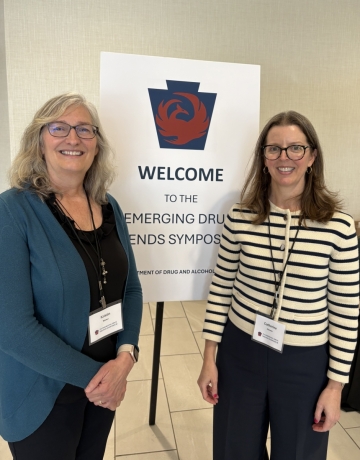
Healthcare professionals are constantly in need of ways to share information and work together in order to advance learning and develop productive relationships among peers. Catherine Abrams and Kristin Walker of the Health Federation of Philadelphia recently teamed up to spread the word about the power of learning collaboratives as a way to accomplish these objectives.
On March 31, they presented an interactive workshop titled "Harnessing the Power of the Group: How Learning Collaboratives Work," at the Pennsylvania Department of Drug and Alcohol Programs (DDAP) Emerging Drug Trends Symposium in Camp Hill, Pa., near Harrisburg.
Abrams, MPH, MMT, is Program Manager of the Substance Use Response, Guidance, and Education (SURGE) Program, and Walker, MSN, RN, is Program Director of Perinatal/Public Health Training and Accreditation at the Health Federation.
“I have found the virtual collaborative meeting format to be extremely useful, so I wanted to spread the word,” Walker said. “And since Catherine and I both facilitate collaboratives that address the needs of people with substance use disorder, our teaming up made sense. So we collaborated on the collaborative content!”
“Our collaboratives have driven a lot of our training activities, so it seemed like presenting about how they work might attract new people to attend them,” Abrams said.
A Q&A with Walker and Abrams about their workshop and work in the learning collaborative space follows:
Question: What types of learning collaboratives have you led or joined in your professional lives?
Catherine Abrams: I lead: Mobile Teams meeting (monthly), Wound Collaborative (bi-monthly) and SUD Learning Collaborative. I belong to Kristin's Perinatal SUD Learning Collaborative and the PA State Harm Reduction monthly calls.
Kristin Walker: I currently lead a Perinatal Substance Use Disorder Learning Collaborative which has been in place since 2021. I often attend Catherine's various SURGE collaboratives as well. In May, I will begin attending a nationwide perinatal SUD collaborative network.
Q: Can you share a concept or best practice regarding learning collaboratives that you might think is surprising or could be particularly beneficial to convey to an audience?
KW: If you're having a quiet start to your meeting, take a breath and embrace the silence. It's so hard to do and can feel really awkward! But people may need a minute to think and process before speaking. It's always helpful to have back-up topics or questions ready to go, in case the quiet doesn't break on its own. But giving conversations a little time is important.
CA: Don't gatekeep information if you are the backbone organization. What other programs and individuals do with that information is out of your control!
Q: Did you receive any interesting feedback or questions from the audience when you gave your recent workshop?
CA: I was surprised to hear that the gambling addiction programs were interested in a collaborative and we also learned about a local program that didn't know that we existed. We were also asked if we could lead a program on behalf of a state-funded program, so we'll see if that pans out!
KW: As it turns out, there are a lot of people who are enthusiastic about starting collaboratives! One participant even said that our program helped her both professionally and personally. I'm not sure how that happened, but it was certainly nice feedback.
About the Health Federation of Philadelphia
The Health Federation of Philadelphia is a public health nonprofit that promotes community health by advancing access to high-quality, integrated, comprehensive health and human services.
The Health Federation of Philadelphia serves as a keystone supporting a network of Community Health Centers as well as the broader base of public and private-sector organizations that deliver healthcare, public health and human services to vulnerable populations.